The Keepsake Album Before the Photo Book
Explore the keepsake album before the photo book and learn how to read mixed mementos, record uncertain clues, and preserve the page order.
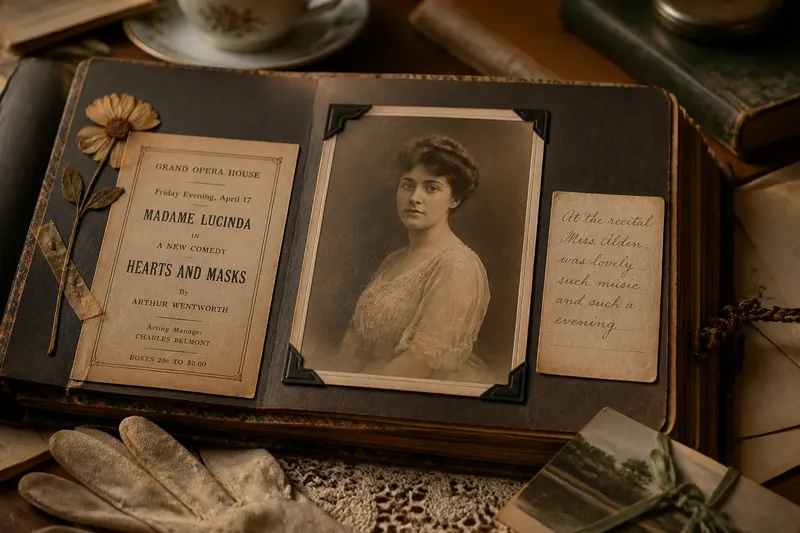
A theater program slips from an old album beside a portrait, and a handwritten note on the next page names someone you have never heard of. The keepsake album before the photo book is easiest to understand by looking at what each page actually holds: photographs, paper objects, and the connections their maker chose to keep.
There is no need to treat these albums as a single historical sequence. Their contents vary, and a mixed page does not reveal exactly when or why it was assembled. The practical distinction is one of emphasis: some albums bring together many kinds of keepsakes, while others organize photographs as the main record.
Keepsake albums connect photographs with paper mementos
A keepsake album may hold calling cards, invitations, theater programs, labels, pressed flowers, handwritten notes, and photographs. An item’s value often comes from its association with a person or occasion, rather than from how polished it looks. The arrangement might be careful, informal, or somewhere between the two.
Imagine you open an album to find a theater program beside a portrait, with no caption. You can record the observable facts: the two items share a page, the program names a performance, and the portrait has no identifying note. The reasonable result is a documented connection in the album, not a claim that the person in the portrait attended that performance.
Image-led albums make photographs the organizing feature
In an image-led album, photographs tend to set the page’s structure. Portraits, snapshots, or scenes may appear in a sequence that invites viewers to follow familiar faces or events. Captions and dates can add context, but the images remain the focus.
That does not mean every photo album contains only photographs, or that every keepsake album contains just a few. A postcard can appear in an image-led album, and a keepsake album can be full of pictures. The distinction is useful when describing what you see: does the page organize several kinds of objects together, or do other items mainly accompany the photographs?
Read the page without turning guesses into facts
An album’s order may seem puzzling because its maker did not arrange it as a complete timeline. Clues such as handwriting, postmarks, printed event details, clothing, and place names can help, but they do not all establish the same thing. Keep direct observations separate from possible interpretations.
- Check whether a photograph has a name written on it; if the name is clear, record it, and if not, leave the identity open rather than guessing.
- Check a postcard for a postmark; if it is legible, transcribe the location and date, and if it is not, note that the mark is unreadable instead of supplying a date.
- Check a program or invitation for a printed event name; if it is readable, copy that detail into an index, and if it is incomplete, record only the legible words.
- Check whether two items are attached or simply stored together; if their relationship is physically clear, describe that arrangement, and if not, avoid claiming they belong together.
- Check a handwritten caption for a person or place; if the writing is uncertain, preserve the uncertain reading with a question mark in a separate note, and if it is clear, transcribe it as written.
- Check whether an item is loose or attached to the page; if loose, note where it was found before placing it in a labeled enclosure, and if attached, leave it in place if moving it could cause damage.
Say you find a postcard tucked near a group portrait. Its postmark is readable, but neither the postcard nor the photograph names the people. Record the postmark and the fact that the postcard was stored beside the portrait; the resulting note preserves a possible association without asserting that the portrait was taken during the trip.
Names and context need careful labels
A face may remain familiar to one relative while its name has disappeared from family conversation. If someone identifies the person, note who supplied the identification and how they describe the relationship. If the identity is uncertain, a phrase such as “possibly Aunt May” keeps that uncertainty visible.
Printed details can also restore context without changing an original page. A short transcription of a ticket, program, or invitation in a separate index gives future readers something to search for while leaving the keepsake untouched.
Handle fragile pages without forcing them
Brittle paper, fading ink, loose inserts, and old adhesives call for a gentle approach. Use a clean, dry work surface and support the album as you open it. Do not force a stuck page or pull an attached item free to improve the layout.
If paper is actively deteriorating, an attachment seems valuable, or a repair appears necessary, ask a qualified paper conservator or an appropriate archival service for advice. For loose keepsakes, a labeled enclosure can keep an item associated with the album without adding adhesive. Write notes on the enclosure, not on the original object.
How should you handle an unclear album?
Should you rearrange pages to make a timeline?
Not before recording the existing order. The arrangement may reflect choices that are no longer obvious, so document it first and keep any later timeline separate from the original album.
How can you label an unidentified photograph?
Write down observable clues, such as a name on the back or a recognizable place. Keep possible identities in a separate note and mark them as uncertain.
Should you remove a keepsake stuck to a page?
Leave it in place if removal would require force or could tear the paper. Ask a qualified conservator for guidance if separating it matters.
Can a digital copy replace the physical album?
A digital record makes pages easier to share and search, but it does not retain the original materials or their physical arrangement. Keep the album and record its page order as part of the same collection.
Record the arrangement before sharing images
Photographing pages in sequence can make the overall arrangement easier to revisit. Take separate detail images when handwriting or a small insert is hard to see, and note where any loose item was found before storing it separately. Include the covers so the record retains the album’s identifying details.
A simple index might say that a page contains two portraits, a handwritten invitation, and an uncertain name. That gives another reader useful clues without presenting a guess as a fact. The keepsake album before the photo book can preserve relationships among objects as well as images; recording those relationships carefully is often more useful than trying to make every page tell a tidy story.